
Editorial Pick
History and Spread of Christianity in Arunachal Pradesh
Current Updates | Editorial Pick | Editorial team | 09-Apr-2026
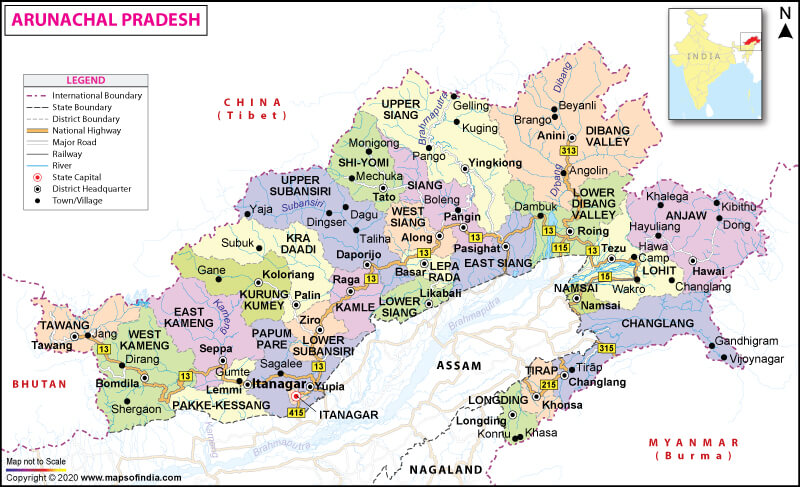
Map of Arunachal of Arunachal Pradesh
Arunachal Pradesh, located in the eastern Himalayas, is one of India’s most culturally diverse and geographically isolated states. Formerly known as the North East Frontier Agency (NEFA), it became a Union Territory in 1972 and attained full statehood in 1987. Historically cut off from the Indian mainland by mountains and forests, the region developed a rich mosaic of tribal societies, languages, and religious traditions. “Land of the Dawn-Lit Mountains,” Arunachal Pradesh is renowned for its breathtaking landscapes, rich biodiversity, and cultural diversity. It is a culturally vibrant and strategically significant state, where tribal heritage, natural beauty, and socio-economic development converge to create a unique context for evangelisation.
Christianity entered Arunachal Pradesh comparatively late. Unlike other parts of Northeast India, such as Nagaland and Mizoram, where Christianity took root in the 19th century, Arunachal witnessed large-scale Christian growth only in the late 20th century. Nevertheless, its expansion has been rapid and socially transformative.
Tribal Diversity
Arunachal Pradesh is home to 26 major tribes and more than 100 subtribes. Prominent groups include: Nyishi, Adi, Apatani, Monpa, Nocte, Wancho, Tangsa, etc.
Most tribal societies traditionally followed animistic belief systems centered on nature spirits, ancestor worship, and ritual specialists. Among the Tani group (Nyishi, Adi, Apatani, Galo, Tagin), the indigenous religious tradition is known as Donyi-Polo—literally “Sun-Moon,” symbolizing cosmic order and moral balance.
2. Colonial and Post-Colonial Restrictions
Western Arunachal, particularly Tawang district, follows Tibetan Buddhism, with Tawang Monastery serving as a major religious center.
Linguistic Profile
The state contains 50+ languages belonging primarily to the Tibeto-Burman family. Due to mutual unintelligibility, Hindi and Assamese often function as lingua francas. Christian missions later played a major role in literacy and Bible translation in tribal languages.
Early Christian Encounters (19th Century)
Baptist Beginnings
The earliest Protestant contact with tribes inhabiting present-day Arunachal Pradesh came through American Baptist missionaries stationed in Assam. Nathan Brown arrived in Sadiya in 1836 under the American Baptist Mission. Although his work focused mainly on Assamese populations, interaction occurred with hill tribes bordering present-day Arunachal.
However, no permanent mission was established inside Arunachal during this period due to British frontier policies restricting entry.
Catholic Martyrdom (1854)
In 1854, French Catholic missionaries Fr. Nicolas Krick and Fr. Augustin Bourry of the Paris Foreign Missions Society attempted to pass through Arunachal on their way to Tibet. They were killed near present-day Walong. Their deaths marked the first recorded Catholic missionary presence in the region.
No sustained Catholic mission followed immediately; the terrain and political conditions made continuity impossible.
Arunachal (then NEFA) was classified as an “Excluded Area” under British administration. Missionary entry required special permission.
After Indian independence (1947), the Government of India maintained tight administrative control over the frontier.
Until the 1960s:
Foreign missionaries were largely prohibited.
Evangelization inside the territory was minimal.
Converts were often those educated outside Arunachal in mission schools in Assam or Meghalaya.
The remoteness, absence of roads, malaria prevalence, and political sensitivity along the China border (especially after the 1962 Sino-Indian War) further limited missionary movement.
The Missionary Journey of the Roman Catholic Latin Diocese of Itanagar
The story of the Diocese of Itanagar is one of faith planted in difficult soil, nurtured through sacrifice, and brought to maturity through perseverance and divine grace. From a time when there was virtually no Catholic presence in the region to its present status as a vibrant and structured local Church, the Diocese stands today as a living testimony to missionary dedication and indigenous response.
Humble Beginnings
The territory that now forms the Diocese of Itanagar was once part of the Diocese of Tezpur. For many decades, missionary activity in Arunachal Pradesh was limited due to the remoteness of the region, difficult terrain, and administrative restrictions. The earliest seeds of faith were sown indirectly through education: young tribal students Who studied in Catholic institutions outside the state encountered the Gospel, embraced the faith, and later carried it back to their villages. These early believers became silent evangelisers. Without infrastructure, without established parishes, and often without resident clergy, small Christian communities began to emerge in scattered pockets. The mission grew quietly, through personal witness, catechesis, and steadfast faith.
Pioneers of Faith: Fr. Vedamuthu Kulandaisamy and Brother Prem Bhai
Among the earliest missionaries whose lives shaped this frontier mission, Fr. Vedamuthu Kulandaisamy and Brother Prem Bhai stand out as exemplary figures. Both dedicated their lives to evangelism, but their methods, challenges, and contributions differed, reflecting complementary facets of missionary zeal.
Early Evangelization and Context
Fr. Kulandaisamy began his mission in the late 1970s as the parish priest of Harmuti, a border parish in Assam close to Arunachal Pradesh. His strategy focused on welcoming tribal visitors, offering catechesis, and baptising those who embraced the faith. By leveraging the relative accessibility of Harmuti, he created the first seed communities among the Nyishi and other tribal groups.
Brother Prem Bhai, by contrast, embarked on a far more daring mission. Entering the interior of Arunachal Pradesh where Catholic presence was nearly nonexistent, he travelled thousands of kilometers on foot, often under harsh conditions and secrecy. Facing social suspicion, physical danger, and the possibility of arrest, he brought the Gospel directly to villages baptizing residents and establishing nascent Christian communities. 4
Missionary Strategies
Fr. Kulandaisamy’s approach was structured and strategic. He linked baptism with formation, inviting visitors to parish centers for systematic catechesis and placing youths in Catholic schools to deepen their understanding of the faith. He trained local catechists, ensuring that newly baptised individuals could serve as leaders in their home villages.
Brother Prem Bhai embodied the itinerant missionary spirit. He often used disguises to enter restricted areas and travelled extensively to villages untouched by any missionary presence. Education was secondary in his early strategy; he prioritised personal witness, sacramental ministry, and the establishment of mission centers, such as the Holy Trinity Ashram in Banderdewa, which laid the foundation for later parish structures.
Areas of Impact
Fr Kulandaisamy's early work resulted in a steady stream of baptisms, the formation of lay catechists, and seed communities that later evolved into organised parishes. Education ensured that the mission’s influence multiplied as students returned to their villages as informed Catholics.
Brother Prem Bhai established the first Christian communities in remote areas, administered baptisms where no Church presence existed, and inspired local vocations. His work expanded the Church beyond accessible regions into Arunachal’s challenging terrain, forming the backbone of the Diocese of Itanagar.
Challenges Faced
Fr. Kulandaisamy faced administrative and logistical challenges—managing the flow of visitors, organising catechesis, and linking early baptisms to ongoing formation—but he operated in a relatively secure environment.
Brother Prem Bhai confronted extreme physical, social, and legal challenges, including arrests, beatings, and threats. He frequently travelled under precarious conditions with minimal resources, yet persisted with extraordinary courage.
Legacy and Complementary Contributions
Fr. Kulandaisamy: Structured formation of early Christian communities, training of catechists and lay leaders, and strategic use of education to ensure sustained growth.
Brother Prem Bhai: Pioneering presence, direct evangelisation in remote areas, establishment of mission centres, and formation of the first Christian communities in interior tribal regions.
Together, they transformed Arunachal Pradesh from a mission frontier into a vibrant Catholic heartland, blending structured formation with courageous outreach, education with evangelisation, and personal witness with community-building. 5
Role of Religious Congregations
Salesians of Don Bosco
The Salesians of Don Bosco were among the first missionary congregations to make sustained inroads into Arunachal Pradesh. Rooted in the charism of St. John Bosco—evangelising youth, the poor, and the marginalised—their work became foundational to the spread of the Catholic Church in the region.
Early Outreach: In the 1970s, priests such as Fr. Jose Chemparathy and Fr. Job Kallarackal began entering mission outposts in eastern Arunachal, providing education and evangelisation.
Don Bosco School and College: Don Bosco School at Jollang (1992) and Don Bosco College (2002) served as centres for education and missionary outreach. Boarding hostels enabled children from remote villages to access schooling, faith formation, and stable community life.
Youth Apostolate: Outreach included oratory services, youth clubs, retreats, and social programs, enabling tribal youth to become active agents of faith.
Missionaries of Charity (Mother Teresa Sisters)
The Missionaries of Charity, founded in 1950 by St. Teresa of Calcutta, arrived in Arunachal Pradesh in 1992, establishing homes at Pappunalla near Naharlagun and in Borduria village.
Mother Teresa’s Visit (1993): Blessed the first Catholic church in Borduria and encouraged the fledgling Christian community.
Service to the Needy: Focused on the poor, sick, and abandoned, providing relief, social care, and pastoral support.
Complementary Role: Their work complemented that of the Salesians and other missionaries, offering a visible witness of charity and compassion.
Canonical Establishment and Growth
On 7 December 2005, the Holy See reached a historic milestone by erecting the Diocese of Itanagar, carving it out of Tezpur. This marked formal recognition of the steady growth and stability of the Catholic community.
Fostering a Church that is a living community rather than a mere institution.
From that moment, the Diocese entered a phase of structured development:
Parishes were organised, pastoral planning strengthened, and vocations encouraged.
Scattered mission stations evolved into a coordinated diocesan network.
Today, the Diocese serves nearly one million people, with over sixty thousand Catholics.
Parish Life and Indigenous Vocations
At the heart of the Diocese is parish life: nearly fifty-five parishes and mission stations now serve communities across multiple districts. Priests and catechists continue to visit remote villages, celebrating sacraments and ensuring even distant faithful remain connected to the Church.
Liturgical celebrations increasingly incorporate local languages and cultural expressions, reflecting a Church authentically Catholic and rooted in tribal identity. Indigenous vocations have risen, with priests and religious drawn from local tribal communities, signifying that the Gospel has taken deep root.
Education, Youth, and Lay Participation
Education has been a cornerstone of missionary outreach. Catholic schools across the Diocese serve thousands of students, irrespective of religion, promoting academic excellence, moral formation, and social responsibility.
Youth and laity play a vital role in evangelization through leadership training, parish councils, and lay associations. Young people are encouraged to grow in faith and service.
Social Commitment and Witness
The Diocese remains committed to social outreach, assisting during emergencies, supporting vulnerable families, and advocating for human dignity. By promoting harmony in a multi-religious environment, it contributes to peace and unity in Arunachal Pradesh.
Lay Associations in the Diocese of Itanagar and Their Role
The Diocese nurtures a vibrant lay apostolate through several formal associations:
- Arunachal Pradesh Catholic Association (APCA)
Coordinates lay faithful across parishes.
Organises catechists’ conventions, training, and spiritual renewal.
Advocates for social justice, peace, and public awareness.
Maintains specialist wings: Health, Nurses, and Legal.
Arunachal Pradesh Youth Association (YUVODAYA)
Provides faith formation and leadership training.
Collaborates with national youth movements (e.g., YCS/YSM/Jesus Youth).
Organises blood donation, humanitarian outreach, and missionary exposure.
Arunachal Pradesh Women Association (APWA)
Promotes women’s spiritual formation and evangelisation.
Supports community outreach and parish ministry integration.
Enhances leadership participation.
Specialist Wings under APCA
Rural health mission/dispensaries
Health and Nurses Wing: medical care and camps
Legal Wing: legal awareness and assistanceDiocesan Empowerment and Social Associations (IDEA)
Commission for Education
Community empowerment through education, literacy, health, and welfare programs
Legal awareness and advocacy
Bridges Church and civil society relations
Overall Role: Lay associations bridge parish pastoral plans with community realities, empower Catholics to live and witness their faith publicly, and ensure the Gospel reaches every corner of society. They embody vibrant laity participation envisioned by the Second Vatican Council.
Looking Ahead with Hope
The journey of the Diocese of Itanagar—from near-zero presence to a vibrant and organized ecclesial community—is a testament to faith sustained through perseverance. The seeds planted decades ago have borne fruit in parishes, schools, vocations, and thriving Christian families.
The Diocese remains guided by three enduring commitments:
- Faithful proclamation of the Gospel
- Deep respect for local culture and identity
- Service to the holistic development of society
The future rests not only in structures and institutions but in the faith of its people. With gratitude for the sacrifices of early missionaries and confidence in indigenous clergy and laity, the Diocese looks forward to continuing its journey as a beacon of hope in the eastern frontier of India.
“What was once a mustard seed has grown into a tree where many find shelter.”
Leave a comment
